 Get an appointment within days, not weeks or months

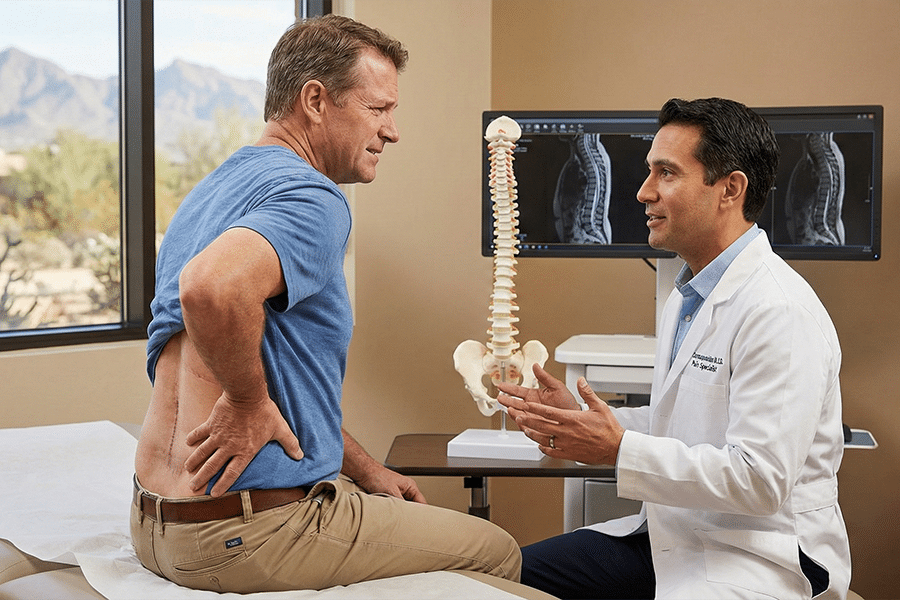
A 2025 prospective cohort study published in Heliyon followed 512 patients after posterior lumbar surgery and found that 32.5% developed failed back surgery syndrome — meaning nearly one in three patients continued to experience significant pain after the operation intended to fix it. For the approximately 500,000 Americans who undergo lumbar spine surgery each year, those odds are sobering. At Arizona Pain and Spine Institute in Mesa, Dr. Daniel Ryklin and Dr. Asim Khan specialize in treating patients whose back surgery did not deliver the promised relief, using interventional approaches including spinal cord stimulation, dorsal root ganglion (DRG) stimulation, and targeted injection therapies — all designed to manage pain without repeat surgery. This article explains what failed back surgery syndrome is, why it happens, and what evidence-based options exist for patients living with it.
What Failed Back Surgery Syndrome Is — Defined by the Medical Community

Failed back surgery syndrome (FBSS) is not an informal term — it carries a specific clinical definition. The International Association for the Study of Pain (IASP) defines FBSS as “lumbar spinal pain of unknown origin either persisting despite surgical intervention or appearing after surgical intervention for spinal pain originally in the same topographical location.” This definition, cited in the StatPearls medical reference maintained by the National Library of Medicine, makes an important distinction: the pain may have existed before surgery and not been adequately resolved, or it may be entirely new pain that developed as a consequence of the surgical procedure itself.
The medical community has recently begun transitioning to a newer term — Persistent Spinal Pain Syndrome Type II (PSPS-T2) — to move away from the word “failed,” which some clinicians argue unfairly implies surgeon error when the causes are often far more complex. A 2023 narrative review published in Medicina notes that PSPS-T2 can affect as many as 20% of patients who undergo spinal fusion procedures specifically.
Regardless of terminology, the clinical reality is the same: a substantial percentage of patients emerge from back surgery still in significant pain. And the data on repeat surgery is particularly striking. A comprehensive review article published in the Asian Spine Journal (2018) documented the diminishing returns of additional operations: while more than 50% of primary spinal surgeries produce successful outcomes, success rates drop to approximately 30% after a second surgery, 15% after a third, and just 5% after a fourth.
Why Back Surgery Fails — The Documented Causes
Understanding why FBSS occurs is essential for determining the right next step. The StatPearls reference identifies FBSS as “a condition with a complex etiology and many factors that predispose patients towards chronic pain.” The causes fall into several documented categories.
Get Back Your Normal Life Again
As pain specialists, we can guarantee that we are more than qualified in alleviating your pain and treating your condition.
Surgical Factors
The Asian Spine Journal review article identifies inadequate patient selection as one of the most critical causes. Not every patient with back pain is an appropriate surgical candidate, and when surgery is performed on patients whose pain does not originate from a surgically correctable structural problem, the operation is unlikely to succeed. Other surgical factors include operating at the wrong spinal level, incomplete decompression of neural structures, and surgical complications such as nerve root damage or dural tears.
Post-Surgical Structural Changes
Even technically successful surgeries can lead to new pain generators over time. Adjacent segment degeneration — where the spinal segments above or below a fusion begin to break down due to increased mechanical stress — is a well-documented phenomenon. The 2024 narrative review in the Yonsei Medical Journal includes imaging examples of patients who developed new pathology at adjacent levels within two years of their initial fusion surgery. Epidural fibrosis (scar tissue formation around the nerve roots) is another common post-surgical development that can cause persistent or new symptoms.
Patient-Related Factors
The 2025 Heliyon study analyzing risk factors in 512 patients identified several patient characteristics associated with higher FBSS incidence, including depression, limited preoperative walking distance (less than 100 meters), and lack of postoperative rehabilitation. The Asian Spine Journal review adds that psychosocial wellbeing has a significant effect on treatment outcomes, noting research by Carragee et al. demonstrating that psychological factors independently predict post-surgical pain persistence.
Neuropathic Pain Development
In some cases, the surgery itself triggers neuropathic (nerve-based) pain that did not exist before the operation. The Medicina narrative review notes that surgical trauma can cause the release of pain mediators — cytokines, bradykinin, and prostaglandins — that create ongoing nerve irritation even after the structural problem has been corrected.
How Arizona Pain and Spine Institute Treats Failed Back Surgery Syndrome
For patients living with persistent pain after back surgery, the prospect of additional surgery offers diminishing odds of success. Arizona Pain and Spine Institute provides an alternative pathway: interventional pain management that addresses the pain itself through non-surgical means.
Spinal Cord Stimulation (SCS)
Spinal cord stimulation is the most extensively studied interventional treatment for FBSS. The procedure involves implanting thin electrode leads in the epidural space of the spinal cord, connected to a small pulse generator. The device sends mild electrical impulses that interrupt pain signals before they reach the brain.
The evidence base for SCS in FBSS is substantial. A systematic review and meta-regression published in Asian Spine Journal analyzing 74 trials found a mean pain relief level of 58% across studies during an average follow-up of 24 months. A 20-year retrospective study of 224 consecutive FBSS patients published in Neurosurgery (2019) found that 78% of patients who underwent an SCS trial proceeded to permanent implantation, and 87% of those patients reported satisfactory outcomes at the two-month mark. A real-world outcomes study published in PMC in 2025, analyzing 505 consecutive SCS trials performed between January 2022 and January 2024, confirmed that evidence for SCS efficacy in FBSS is “particularly robust, with randomized controlled trials demonstrating its superiority over repeat surgery and conservative treatments for both low back and radicular leg pain.”
At Arizona Pain and Spine Institute, Dr. Ryklin and Dr. Khan are among the few physicians in the East Valley trained to perform both SCS and DRG procedures. The practice’s published materials describe SCS as working “similar to how a pacemaker regulates heartbeat” — it interrupts pain signals rather than curing the underlying structural issue, but the resulting pain relief can be transformative for patients who have exhausted other options.
Critically, SCS includes a trial period before permanent implantation. The practice implants a temporary device that allows patients to evaluate whether the stimulation provides adequate relief before committing to the permanent system. This “try before you buy” approach reduces the risk of patients undergoing a procedure that does not work for them.
Dorsal Root Ganglion (DRG) Stimulation
DRG stimulation represents a newer evolution of neurostimulation technology. Rather than placing leads along the spinal cord itself, DRG stimulation targets the dorsal root ganglion — a cluster of neurons at the base of the spinal cord through which all sensory signals pass. Arizona Pain and Spine Institute’s published information notes that “emerging evidence suggests that DRG-S may alleviate pain by several mechanisms, including the reduction of nociceptive signals at the t-junction of sensory neurons.”
The advantage of DRG stimulation is its ability to provide more targeted pain relief, particularly for focal pain in the legs and feet — a common complaint among FBSS patients. The practice states that studies “have shown that an even higher percent of patients had significant pain relief” with DRG stimulation compared to traditional SCS, specifically for focal pain conditions.
Epidural Steroid Injections
For FBSS patients whose pain has an inflammatory component, epidural steroid injections deliver anti-inflammatory medication directly to the affected area of the spine. Arizona Pain and Spine Institute offers both cervical and lumbar epidural steroid injections as part of its treatment menu. These are typically used as part of a broader treatment plan rather than as a standalone solution.
Radiofrequency Ablation (RFA)
Radiofrequency ablation uses heat generated by radio waves to target specific nerves transmitting pain signals. For FBSS patients whose pain originates from facet joints — a documented source of post-surgical pain, with one study cited in the Yonsei Medical Journal review finding facet joint pain present in a significant percentage of post-surgical patients — RFA can provide relief lasting months to over a year.
The Individualized Treatment Plan
Arizona Pain and Spine Institute’s approach to FBSS reflects the broader multimodal philosophy that Dr. Khan has articulated publicly: “A doctor who only offers one type of treatment — whether that’s medications, injections, or even regenerative therapy alone — is like a carpenter with just one tool.” For FBSS specifically, this means the treatment plan may combine multiple modalities — for example, spinal cord stimulation for the primary neuropathic pain component alongside targeted injections for inflammatory or facet-related pain.
Why Repeat Surgery Is Often Not the Answer — What the Data Shows

One of the most important decisions a patient with FBSS faces is whether to undergo another operation. The clinical evidence strongly suggests caution.
The Asian Spine Journal review’s documentation of declining success rates — from over 50% for first surgeries to just 5% by the fourth — represents one of the most cited statistics in FBSS literature. The Medicina narrative review adds context: PSPS-T2 “does not have a single unified pathology at the molecular level,” meaning repeat surgery addresses only one potential contributor (structural) while leaving neuropathic, inflammatory, and psychosocial factors untouched.
The UK’s National Institute for Health and Clinical Excellence (NICE) analyzed the cost-effectiveness of spinal cord stimulation compared to both conventional medical management and reoperation for FBSS, and recommended approval of SCS in selected patients — a decision informed by evidence that SCS provides better health outcomes at lower long-term cost than repeat surgery. A 24-month real-world study published in Pain Practice found that SCS improved health-related quality of life, with EQ-5D utility scores improving from 0.22 at baseline to 0.63 at 24 months in the SCS group, compared to essentially unchanged scores in the conventional management group.
What Patients Should Do Next — A Practical Pathway
For patients experiencing persistent or new pain after back surgery, the following steps are based on documented best practices and Arizona Pain and Spine Institute’s published approach:
- Acknowledge the Problem Early: The Asian Spine Journal review emphasizes that duration of pain before treatment is a significant predictor of outcomes — longer pain duration produces lower treatment response. Do not wait years hoping pain will resolve on its own.
- Get a Comprehensive Evaluation: Arizona Pain and Spine Institute’s initial consultations last 60 minutes or more and assess not just the pain location, but its impact on function and daily life. This evaluation should include imaging review, neurological assessment, and discussion of all prior treatments.
- Explore Non-Surgical Options First: Given the documented diminishing returns of repeat surgery, interventional approaches like SCS, DRG stimulation, targeted injections, and RFA should be evaluated before considering another operation.
- Consider the SCS Trial: The ability to test spinal cord stimulation before permanent implantation is a significant advantage. Contact Arizona Pain and Spine Institute at (480) 986-7246 or visit gotpainarizona.com to discuss candidacy.
- Use the FastTrack Program if Needed: For patients in significant pain who cannot wait for insurance authorization, Arizona Pain and Spine Institute’s cash-pay FastTrack program provides appointments within days — critical for a condition where treatment delay worsens outcomes.
Conclusion
The 2025 Heliyon study finding that 32.5% of lumbar surgery patients develop failed back surgery syndrome — combined with the Asian Spine Journal‘s documentation that repeat surgery success drops to just 5% by the fourth operation — makes a compelling case for exploring non-surgical alternatives. Spinal cord stimulation, DRG stimulation, epidural steroid injections, and radiofrequency ablation represent evidence-based options that address post-surgical pain through fundamentally different mechanisms than another operation.
At Arizona Pain and Spine Institute, Dr. Ryklin and Dr. Khan bring specialized training in these advanced procedures to patients across Mesa, Gilbert, Queen Creek, Chandler, Scottsdale, and Tempe. If your back surgery did not deliver the relief you expected, the next step is a comprehensive evaluation — not necessarily another surgery. Contact Arizona Pain and Spine Institute at (480) 986-7246 or schedule through gotpainarizona.com.
Frequently Asked Questions
1. What is failed back surgery syndrome?
The International Association for the Study of Pain defines it as lumbar spinal pain persisting or appearing after surgical intervention. StatPearls reports it affects 10–40% of lumbar surgery patients depending on the procedure type and clinical setting.
2. Is spinal cord stimulation effective for failed back surgery syndrome?
A meta-regression of 74 trials found an average 58% pain relief level over 24 months. A 2025 real-world outcomes study of 505 patients confirmed SCS superiority over repeat surgery and conventional management for FBSS.
3. Can I try spinal cord stimulation before getting it permanently?
Yes. Arizona Pain and Spine Institute performs a temporary trial implant that lets you evaluate whether SCS provides adequate relief before committing to permanent implantation. The trial typically lasts one to two weeks.
4. Should I get a second back surgery if the first one failed?
Data shows success rates drop significantly with each additional surgery — from over 50% for the first to just 5% by the fourth. Non-surgical interventional options should be evaluated before considering reoperation.
5. How do I schedule an FBSS evaluation at Arizona Pain and Spine Institute?
Call (480) 986-7246 or visit gotpainarizona.com to schedule a comprehensive evaluation at the Mesa, East Mesa, or Queen Creek locations. The FastTrack cash-pay program provides expedited appointments within days.
Disclaimer: This article references publicly available information from Arizona Pain and Spine Institute (gotpainarizona.com), the International Association for the Study of Pain (IASP), the National Library of Medicine (StatPearls, updated May 2023), the Asian Spine Journal (2018), Medicina (2023), Heliyon (2025), Neurosurgery (2019), Pain Practice (2021), the Yonsei Medical Journal (2024), and the UK National Institute for Health and Clinical Excellence (NICE), including official definitions, peer-reviewed clinical studies, and published practice information dated 2018–2025. All metrics and study findings are from documented, peer-reviewed sources. Results described are specific to the study populations and clinical settings mentioned and may vary based on individual patient circumstances, surgical history, pain etiology, and treatment adherence. Failed back surgery syndrome is a complex, multifactorial condition; treatment decisions should be made in consultation with a qualified pain management specialist. For current information about treatments offered at Arizona Pain and Spine Institute, consult gotpainarizona.com or call (480) 986-7246.